Dina Lelic
Principal Scientist, Denmark

Negativity bias is a psychological phenomenon where negative experiences feel more significant than positive ones. In hearing care, this means that hearing aid benefits can be overshadowed by difficult listening situations, negatively influencing user satisfaction and, in turn, hearing aid use.
Research in positive psychology has shown that intentionally focusing on positive emotional experiences can help counteract negativity bias.
We conducted a series of studies to determine whether Positive Focus, an intervention that encourages hearing aid users to reflect on positive listening experiences, could improve hearing aid outcomes.
We assessed the effects of Positive Focus on hearing aid benefit and satisfaction in both first-time and experienced users across three studies. In a subsequent follow-up study, we examined how emotional responses to everyday sounds may influence the effectiveness of the Positive Focus intervention
In all four studies, participants were divided into two groups: one group documented and reflected on positive experiences, while the control group continued using their hearing aids as usual.
We primarily evaluated:
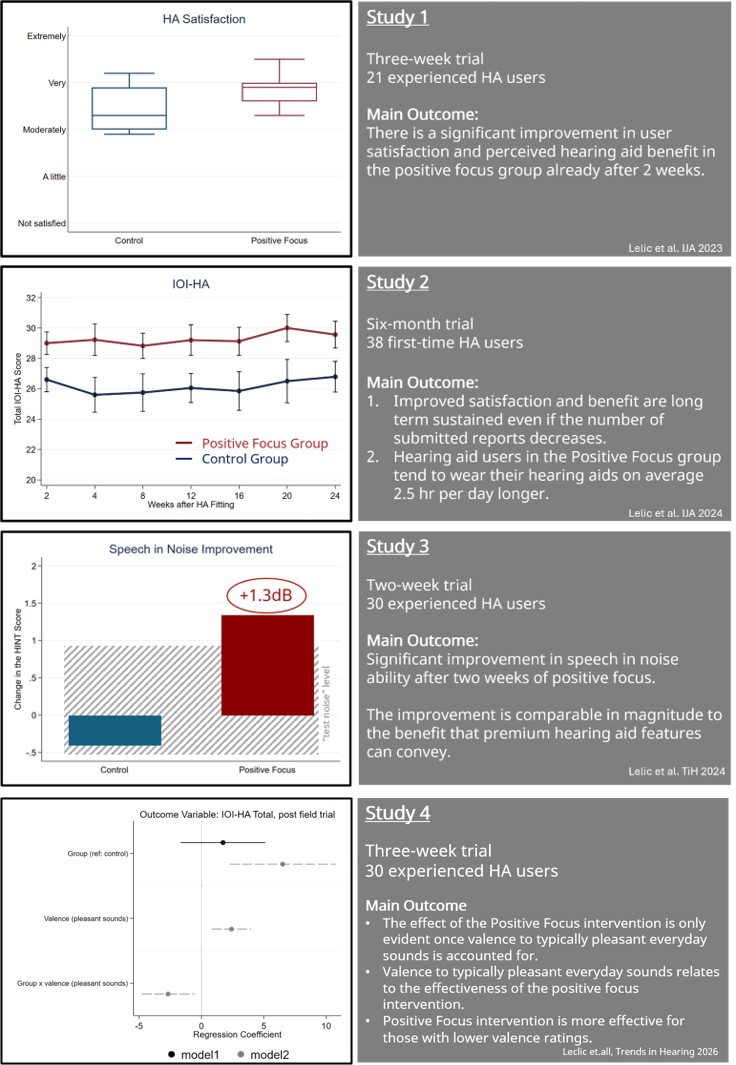
Study 1: Three-Week Trial investigating experienced self-reported hearing aid benefit and satisfaction (21 Experienced Users)
Study 2: Six-Month Trial investigating experienced self-reported hearing aid benefit and satisfaction (38 First-Time Users)
Study 3: Two-Week Trial investigating measured speech-in-noise abilities (30 Experienced Users)
Study 4: Three-Week trial exploring how emotional responses to everyday sounds influence effectiveness of the Positive Focus intervention (30 Experienced Users)
Overall, the Positive Focus studies highlight the importance of encouraging hearing aid users to focus on positive listening experiences to improve both short- and long-term outcomes.
The results from first-time users suggest that reflecting on positive listening experiences during the critical hearing aid onboarding period can have lasting effects.
Our research continues to investigate positive listening experiences from multiple perspectives. As the research program evolves, we aim to better understand how behavioral and psychological factors contribute to successful hearing rehabilitation and how these insights can inform more person-centered approaches to hearing care.

By integrating Positive Focus into audiological care, we can:
Our research suggests that successful hearing rehabilitation involves more than improving audibility alone. Alongside hearing technology, behavioral and psychological factors may influence how people adapt to hearing aids and experience everyday listening.