Tapping into Hearing-Aid Personalisation: A Qualitative Framework for Understanding the Process of Developing Sound Preferences.
By Dr Bill Whitmer and Dr Janin Benecke of the Hearing Sciences, Scottish Section, University of Nottingham, UK.
Skip to content
Winner of the ORCA Labs Grant 2026
In Focus October - November 2026
Congratulations to the winner of the ORCA Labs Grant: Sound Preference
ORCA Labs Grant
Why does the same sound feel right to one person and wrong to another?
That question was the starting point for the first ORCA Labs Grant, focused on Sound Preference.
While hearing research has generated extensive knowledge about hearing loss, hearing technology, and speech understanding, much remains to be learned about why people experience sound differently and how they form preferences for different listening experiences.
The Research Grant attracted 25 strong applications from researchers across the hearing research community. The proposals covered a wide range of questions related to understanding how people experience and evaluate sound.
Following review and discussion by the Sound Preference Advisory Board, one project was selected for funding:
The Tapping into Hearing-Aid Personalisation: A Qualitative Framework for Understanding the Process of Developing Sound Preferences project.
The Winning Project
Tapping into Hearing-Aid Personalisation: A Qualitative Framework for Understanding the Process of Developing Sound Preferences
The first ORCA Labs Grant has been awarded to Dr Bill Whitmer and Dr Janin Benecke of the Hearing Sciences, Scottish Section, University of Nottingham, UK.
Building on their recent work on hearing-aid self-adjustment, Whitmer and Benecke will investigate a broader question: how sound preferences form and what shapes people’s decisions when comparing different listening experiences.
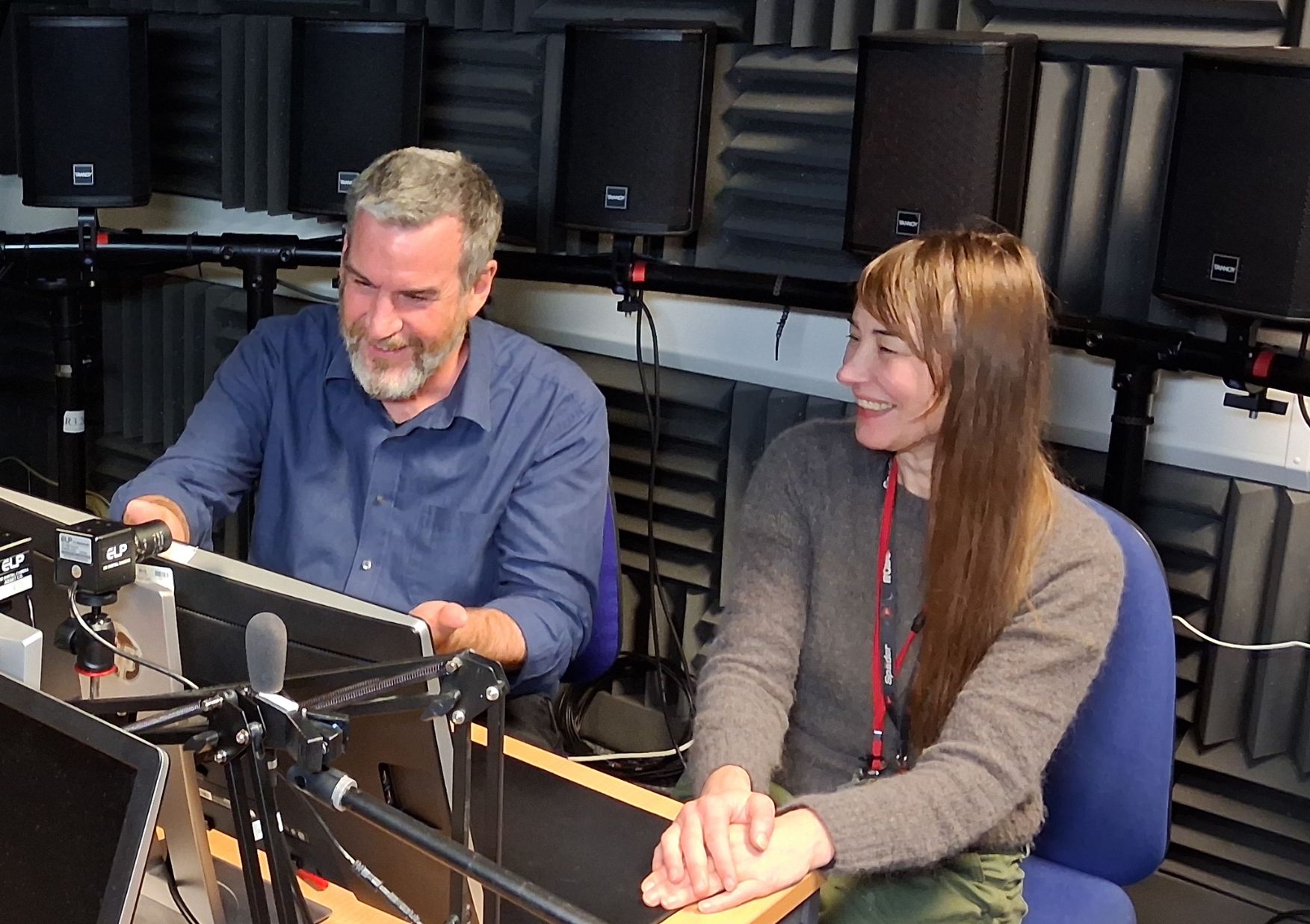
Whitmer and Benecke
From Expectation to Sensation to Preference
The challenge
This or That?
We make preference-based choices all the time. Sometimes the choice is based on use, other times on appearance, but most often we weigh several factors against one another depending on the situation.
The same is true when comparing hearing aids. Listeners may prefer how a particular situation sounds with one hearing aid compared with another.
Despite major advances in hearing aids and knowledge about their usefulness in everyday situations, how people make hearing-aid choices is still not fully understood.
Whitmer and Benecke suggest that one reason may be that studies of hearing-aid personalization frequently describe outcomes as “preferences” without examining the reasoning behind those choices.
Studies may identify which setting a listener selected, but tell us much less about why they selected it.
The project starts from the idea that understanding sound preferences also means understanding people’s intentions, whether they made compromises, and which criteria guided their decisions.
As Whitmer and Benecke put it in their application:
Whitmer and Benecke
But how can we understand how that preference develops? Quite simply: We ask them.
The winning approach
Listening and Thinking Aloud
To investigate these questions, the researchers will use the Think-Aloud Protocol (TAP).
TAP has been used for decades to understand how people interact with technology and make decisions. Rather than focusing on whether a task is completed successfully, it aims to understand the thought processes involved while the task is taking place.
Whitmer and Benecke recently used TAP in a study of hearing-aid self-adjustment involving experienced hearing-aid users. Participants were asked to verbalise their thoughts while adjusting hearing-aid gain to their preferred settings.
The study showed that participants could verbalise their thoughts to varying degrees. It also revealed differences in how they approached and navigated the self-adjustment process, ranging from exploratory to anticipatory approaches.
The current project extends this work from hearing-aid self-adjustment to the broader topic of sound preference.
Participants will compare sounds produced by different hearing aids and hearing-aid programmes while thinking aloud.
The researchers suggest that TAP may be particularly useful for auditory evaluation because auditory memory is brief. Describing impressions while listening may capture aspects of the evaluation process that could otherwise be lost when reported afterward.
The Sound Preference Advisory Board highlighted the researchers’ use of TAP in its assessment:
Sound Prefderence Advisory Board
This established methodology will provide novel insights into what people prefer, and how those preferences are formed.
The questions they ask
Questions the Study Will Address
The researchers have identified four main research questions:
- How do participants form preferences in a pairwise-comparison task? Which factors influence perceptual judgements, and how are conflicting impressions resolved
- How does the sound scenario influence preference formation? Does the personal relevance of the scene affect how listeners evaluate and choose a preferred sound?
- Can behavioural measures of task interaction indicate potential preference biases (e.g., does longer or repeated exposure to a particular sound predict subsequent preference)?
- How reliable are preference judgements? How reliable are concurrent verbalisations? Does thinking aloud influence the consistency of preference choices?
The outcome
Building a Framework for Understanding Preference
The researchers aim to develop a qualitative framework that describes the processes underlying sound preference decisions, including cases where no clear preference exists.
The framework will be developed through qualitative analysis of participants’ verbalised thoughts, alongside quantitative analyses of preference judgements and task behaviour.
Participants will also be invited to review and help refine the qualitative themes developed from their think-aloud contributions.