Latest publications
2026
HeAL 2026
This year at HeAL 2026, ORCA Labs will present new research exploring one of the most fundamental and often overlooked questions in hearing care:
Why does the same hearing aid sound feel right to one person and wrong to another?
Modern hearing aids are highly advanced and effective at improving audibility and speech understanding. Yet many users still struggle to adapt to amplified sound in everyday life, even when devices are technically well fitted. Some describe sound as natural and comfortable, while others experience it as tiring, sharp, artificial, or overwhelming.
For years, hearing care professionals have observed these differences in practice. At ORCA Labs, we have been investigating whether these experiences reflect something deeper: individual sound preference.
At HeAL 2026, Gitte Engelund and Frederic Marmel will present a joint session bringing together theoretical, experimental, and clinical perspectives on sound preference and personalized hearing care.
Across three complementary presentations, the session explores how sound preference develops, how it can be assessed, and how listeners themselves describe meaningful differences in sound experiences.
Traditional hearing rehabilitation has primarily focused on audibility, speech understanding, and fitting precision. But hearing is more than detecting sound. It is also emotional, cognitive, and deeply connected to identity, comfort, and everyday participation.
Our research suggests that successful hearing rehabilitation may depend not only on hearing better, but also on whether sound feels manageable, meaningful, and personally right.
This work began with comparative studies investigating listener preferences for fundamentally different hearing aid sound processing philosophies including time-domain and frequency-domain processing approaches.
Across large-scale online listening studies and real-world guided walk studies, listeners consistently demonstrated highly individual and systematic preferences for different sound experiences.
Importantly, these preferences could not easily be predicted by traditional clinical categories such as hearing loss, age, or lifestyle. Instead, participants described their preferences using nuanced and personal experiences such as naturalness, listening effort, immersion, comfort, and clarity without strain.
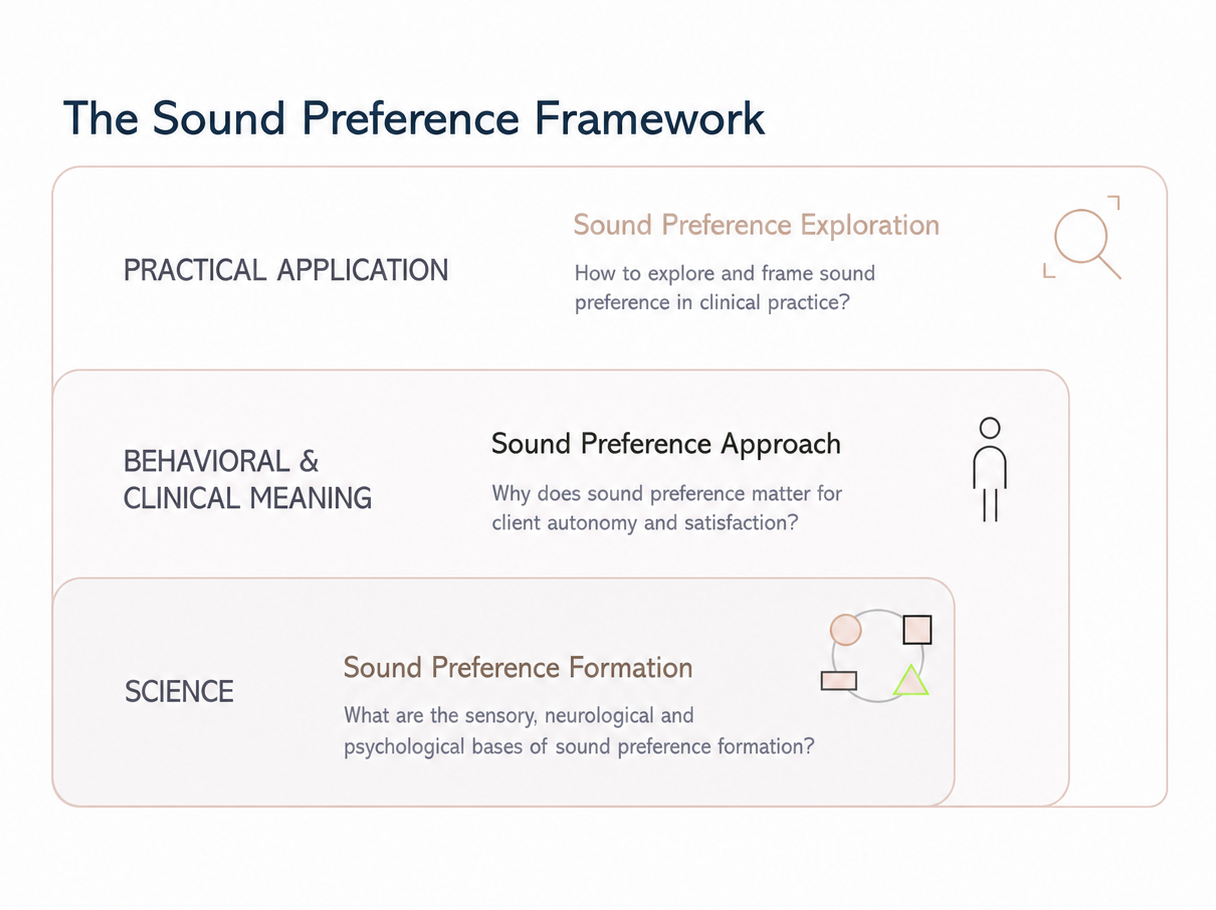
Together, these findings led to the development of the Sound Preference Framework; a new conceptual approach exploring how sensory comfort, emotional reward, cognitive ease, and social meaning shape the experience of amplified sound.
Gitte will introduce a conceptual Sound Preference Framework that sheds light on how sound preferences are formed, why sound preference choice is essential to client empowerment, autonomy, and engagement, and how hearing care professionals can meaningfully incorporate Sound Preference Exploration into rehabilitation.
Building on this foundation, Frederic will present new empirical findings demonstrating the highly individual nature of clients’ preferences for different hearing aid sound designs and introduce a novel, clinically applicable tool for assessing these preferences.
Together, these presentations highlight a broader shift in hearing care from focusing primarily on technical optimization toward understanding the lived human experience of sound.
At ORCA Labs, we believe that hearing care should not only restore audibility, but also help individuals reconnect with sound in ways that feel comfortable, meaningful, and empowering in everyday life.