In Focus September 2026
IHCON 2026: Looking Beyond Speech Understanding in Noise
What's in focus
Speech Understanding in Noise
At this year’s IHCON in Banff, Canada, ORCA Labs presented an innovative clinical tool that extends traditional speech-in-noise testing by also measuring auditory working memory, reliance on semantic context, and listening effort.
The approach aims to provide a more complete understanding of the real-world communication challenges experienced by people with hearing difficulties.
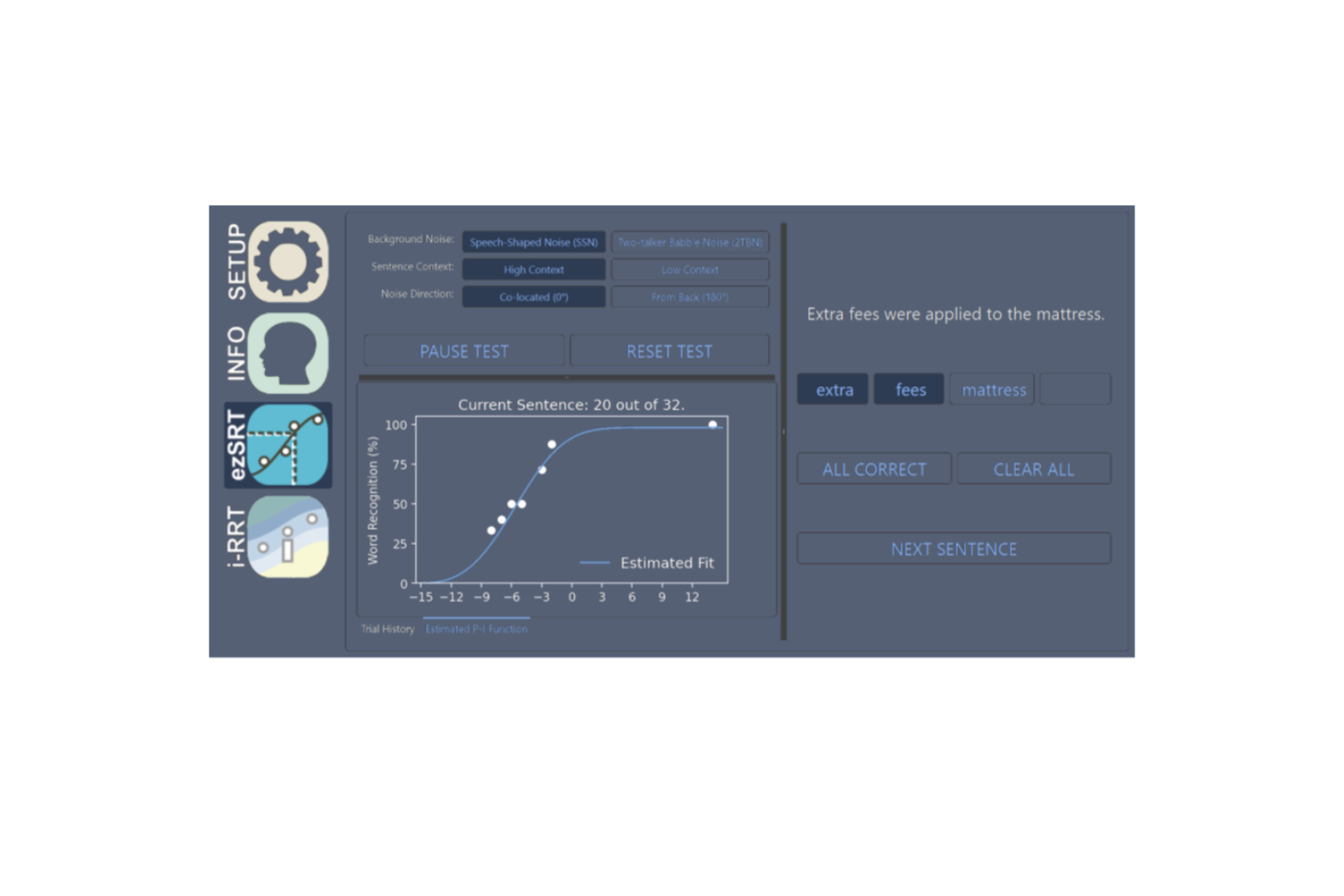
New innovative tool
The Cognitive Cost of Communicating in Noise
Understanding speech in noisy environments is a challenge for many people with hearing loss.
Traditional speech-in-noise (SiN) tests often focus only on whether words are correctly recognized.
The Repeat-Recall Test (RRT) was developed to provide a more complete picture by assessing not only speech understanding, but also the cognitive effort, memory demands, and listening experience associated with everyday communication.
We combined the RRT with the ezSRT, a Bayesian adaptive testing method that efficiently determines an individual’s speech-reception threshold (SRT).
RRT materials have been adopted for use in a Bayesian-guided adaptive SiN protocol, known as the “easy” speech reception threshold (ezSRT) test.
The ezSRT is designed to efficiently estimate a listener’s complete psychometric function for different SiN conditions.
This innovation enabled the creation of the new protocol called the intelligibility-based Repeat-Recall Test (i-RRT), allowing listeners to be tested at personalized listening conditions corresponding to specific levels of speech understanding (25%, 50%, 75%, and 90% word recognition).
Study Evaluation
Evaluation of the Intelligibility-Based Repeat-Recall Test (i-RRT)
The study with 20 listeners with normal hearing and 20 listeners with hearing loss confirmed that the ezSRT accurately targets individualized speech-in-noise performance levels and that the i-RRT provides reliable measures of:
• Auditory working memory and recall
• Listening effort
• Motivation to continue communication in noise (“tolerable time”)
• Dependence on semantic context
Findings
Benchmarking Listening Performance with Normative References
i-RRT incorporates normative references, derived from data from listeners with normal hearing, for each outcome measure at multiple SRT levels.
These benchmarks were then used to evaluate listeners with hearing loss.
The results showed that factors such as the availability of semantic context, the type of background noise, and hearing status influence memory performance, listening effort, and motivation, even when speech intelligibility is held constant.
These results highlight that speech-in-noise difficulties cannot always be explained by audibility alone.
By comparing individual performance against intelligibility-matched normative references, the i-RRT offers a new way to identify hearing-related challenges that may persist even when speech understanding improves.
This approach could ultimately support more personalized assessment and management of real-world communication difficulties.