In Focus December 2025
Improvement of attention to target speech by adaptive amplitude compression in hearing impaired users
What's in focus Introduction
ORCA Labs at EUHA 2025
ORCA Labs participated in EUHA 2025, which took place in Nuremberg from October 22 to October 24, 2025. It was an inspiring meeting, where we also had the chance to share some of our recent research.
Ronny Hannemann held a presentation on the effect of amplitude compression on attentional neural speech tracking based on a paper authored by Martin Orf, Ronny Hannemann and Jonas Obleser, being a result of Martin Orf’s PhD.
"The findings indicate that intelligent compression algorithms with variable compression ratios applied to separated sources, could help individuals with hearing loss suppress distraction in complex multi-talker environments."
Explore Presentation of study
Introduction to study
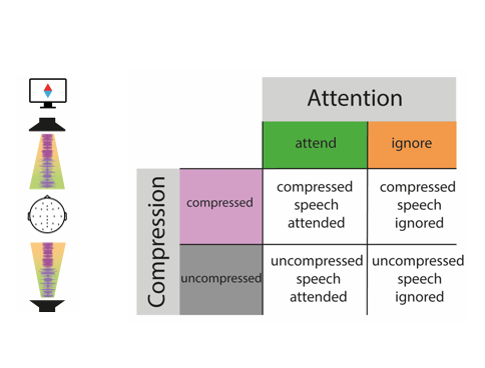
In the presented study, they tested normal-hearing (NH), older hearing-impaired (HI), and older normal hearing individuals in dual-talker scenarios, where the participants were asked to attend their focus to one of the speech streams and ignore the other stream. At the same time, envelope compression was applied on both speech streams or only on one speech stream. The compression ratio of 1:8 was determined based on a pilot experiment. After applying the compression, loudness matching between compressed and uncompressed speech streams was applied. The audio streams were presented simultaneously in time but spatially separated.
The participants had to detect short syllable repeats in the target stream and ignore them in the to-be-ignored stream. Meanwhile, EEG was used to measure neural activity via scalp electrodes.
Explore Study Results
Results of the study
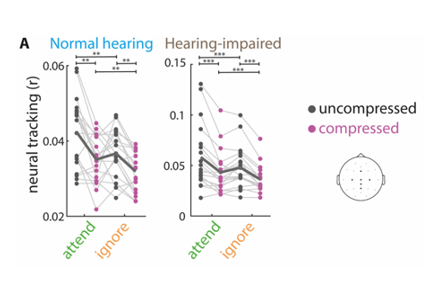
In the study it was found that attention leads to an increased proportion of detected repeats in both groups, and that amplitude compression impaired repeat detection performance in hearing-impaired participants. Repeating findings of numerous previous studies, both groups showed stronger neural tracking of attended speech compared to ignored speech. However, the study also showed that participants exhibited decreased neural speech tracking for compressed speech compared to uncompressed speech.
Most interestingly, they reported that compressing the ignored stream only results in an increased neural contrast between attended and ignored speech streams. This effect was larger for hearing-impaired participants.
Additionally, age-matched comparisons between normal-hearing and hearing-impaired older adults revealed larger neural contrast arising from decreased tracking of the compressed ignored stream and enhanced neural representation of the attended stream for hearing-impaired participants when the ignored stream is compressed compared to when the ignored stream is uncompressed.
Explore Conclusion
Conclusion
In short, during a cocktail party situation, attention to target speech can improve if amplitude compression is applied only to the sounds you’re trying to ignore. When the background speech is compressed more strongly for hearing impaired user, the brain represents the main speech (the one you want to focus on) more clearly without completely removing the useful background information. Consequently, hearing aids featuring independent compression for distinct sources could be the preferred choice for enhancing communication in complex environments.