In Focus October-November 2025
Industrial PhD project by Borgný Súsonnudóttir completed
What's in focus Introduction
Introduction
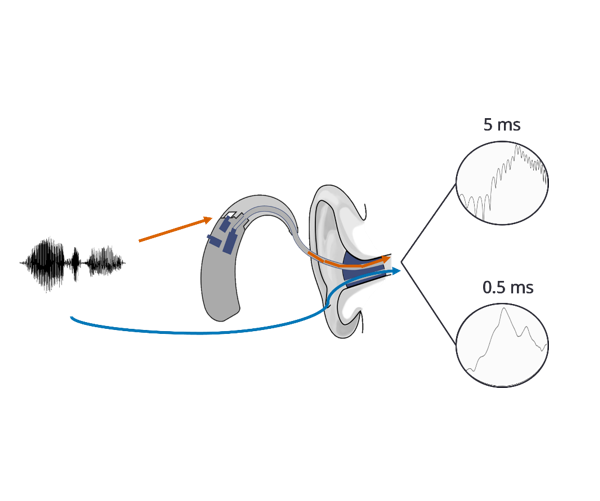
Digital hearing aids introduce a delay between the direct sound entering the ear and the processed sound delivered by the device. In open-fit designs, this can lead to comb-filter effects, which distort sound quality. Most previous studies on hearing aid processing delay focused on identifying the upper limit of tolerable delay (typically 5–10 ms). This thesis is among the first to systematically explore the lower limit—specifically, whether very short delays (≤0.5 ms) offer perceptual advantages, thereby shifting the focus from “how much delay is too much” to “how little delay is enough for optimal sound quality”.
Explore PhD related study
Study I: Individual Differences Underlying Preference for Processing Delay in Open-Fit Hearing Aids
Study I explored how different processing delays—from 0 to 10 milliseconds—affect perceived sound quality in open-fit hearing aids. Using a hearing aid simulator, participants with normal hearing and mild-to-moderate hearing loss compared various delays across different sound types. The results showed a clear preference for short delays (0–0.5 ms) over longer delays shorter and in the commercial range (2-10 ms). Importantly, the study found that individuals with better spectral resolution—measured through a spectral ripple discrimination (SRD) task—were more likely to prefer shorter delays. This suggests that SRD could be a useful tool for identifying candidates who would benefit most from short-delay hearing aids.
Study I is published in Trends in Hearing:
Súsonnudóttir B, Kowalewski B, Stiefenhofer G, Neher T. Individual Differences Underlying Preference for Processing Delay in Open-Fit Hearing Aids. Trends in Hearing. 2024;28. doi:10.1177/23312165241298613
Explore PhD related study
Study II: Own-Voice Perception with Different Processing Delays in Open-Fit Hearing Aids
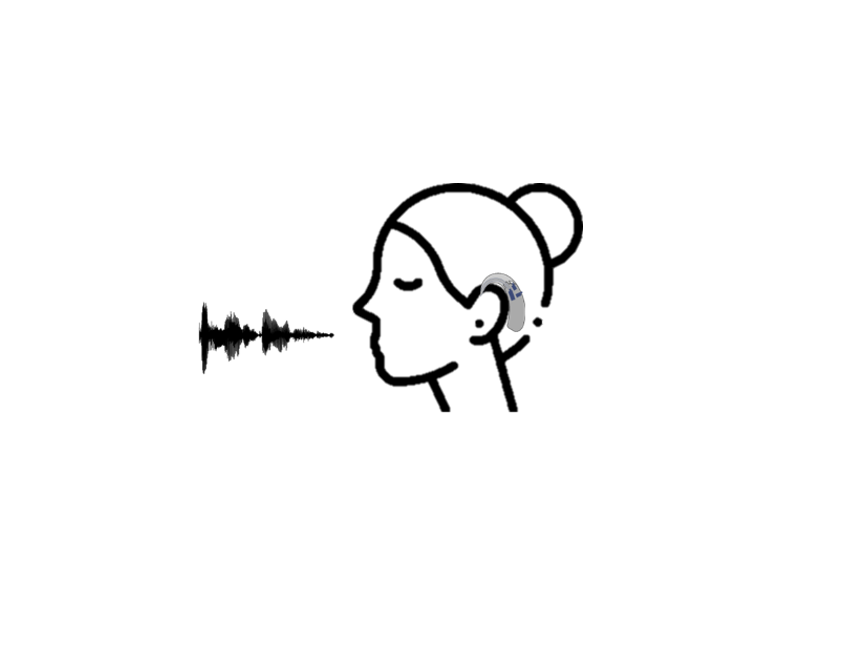
Study II focused on how processing delay influences the perception of one’s own voice—a common source of dissatisfaction among hearing aid users. Using wearable hearing aids with delays of 0.5, 5, and 10 ms, participants evaluated how their voice sounded in real time. The shortest delay (0.5 ms) was consistently preferred over the longest delay (10 ms). A customized version of the Own Voice Qualities (OVQ) questionnaire revealed that longer delays led adverse effects on the perception of tonality, reverberation, and own-voice sound quality. Interestingly, unlike in Study I, SRD ability did not predict delay preference in this context, suggesting that own-voice perception may rely on different auditory cues.
Explore PhD related study
Study III: The Influence of Processing Delay in Open-Fit Hearing Aids on Real-Life Experiences: A Pilot Study
The third study moved beyond the lab to assess how processing delay affects real-life hearing aid use. Over a two-week field trial, participants wore hearing aids with either 0.5 ms or 10 ms of delay for one week each. They completed daily and weekly questionnaires and participated in an exit interview. While the questionnaires showed only subtle trends favoring the shorter delay, the exit interviews revealed a clear preference for the 0.5 ms delay, thereby extending lab-based preference-findings into real-life preference. The study highlights the importance of minimizing delay in open-fit hearing aids to improve everyday user experience.
In Focus Summary
Summary
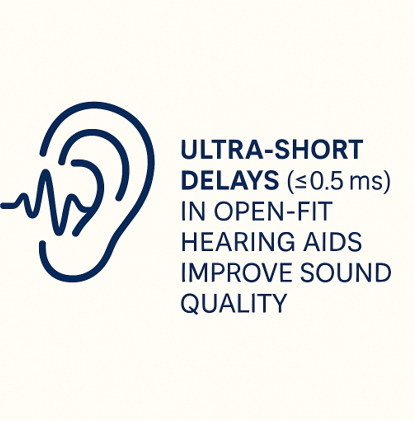
In summary, short processing delays, particularly around 0.5 milliseconds—are consistently preferred over longer delays. Participants’ ratings showed that 10 ms delay was associated with adverse effects on reverberation, tonality perception, and overall own-voice sound quality. Since own-voice perception plays a crucial role in hearing aid satisfaction, these findings highlight the importance of minimizing delay. Notably, real-life user preferences aligned with laboratory results, reinforcing the clinical relevance of short-delay hearing aids for improving everyday listening experiences.
If you are interested in more details about the study, see the attached thesis below.
Acknowledgements
- Innovation Fund Denmark
- WS Audiology
- Supervisors and collaborators at SDU and ORCA Labs